Implant Dentistry Is More Advanced Than Ever—So Why Is It Still So Disconnected?
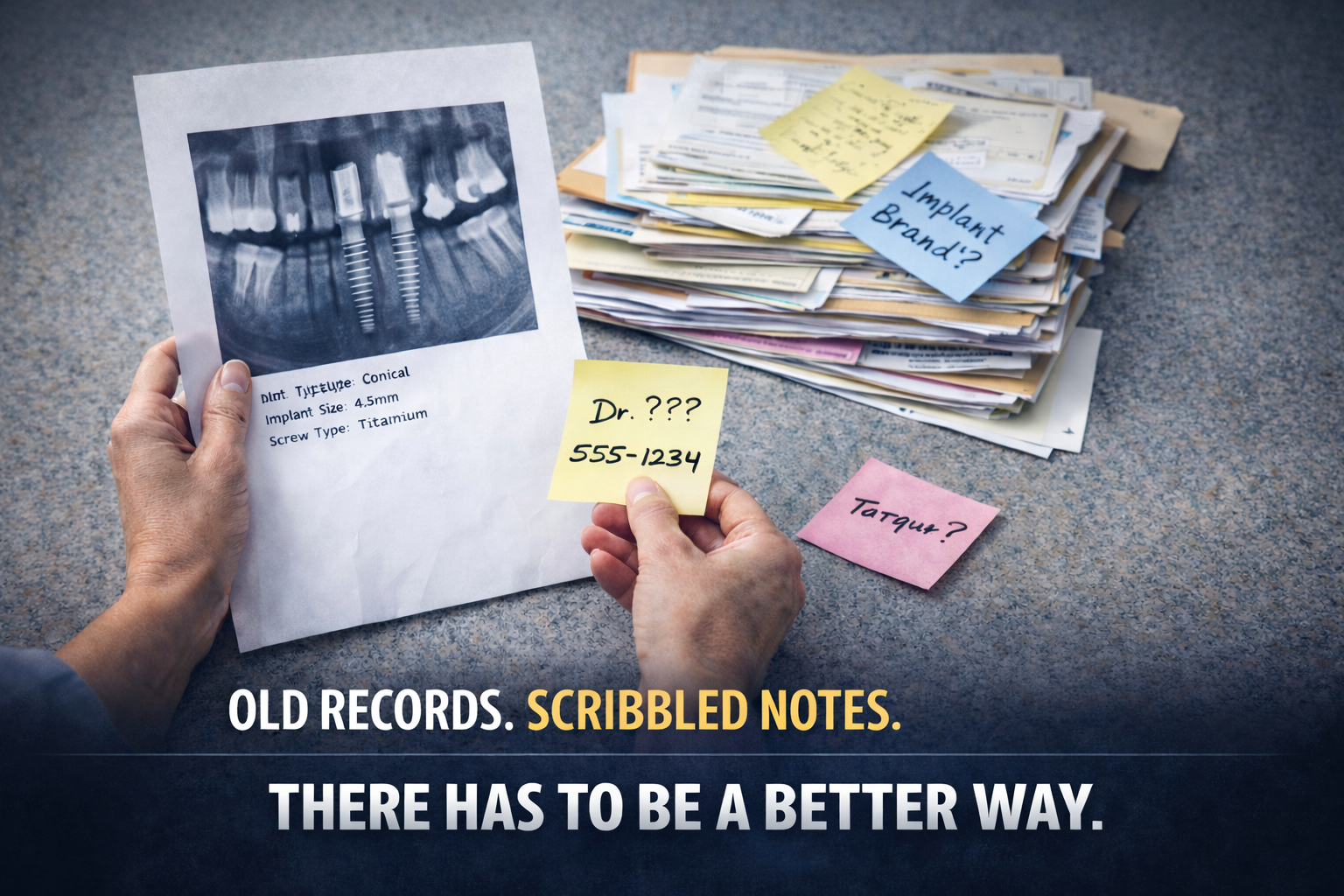
A patient receives an implant, completes treatment, and moves on with life. A few years later, they move to another city. Or their restorative dentist retires. Or they travel and something unexpected happens—a loose crown, a fractured screw, a component that needs replacement, or a restoration that simply needs maintenance. They walk into a new dental office assuming the next step will be straightforward. Instead, the room slows down. The clinician starts asking the questions no patient should ever have to answer. What implant system was placed? What connection type is it? What platform? What components were used? Was it restored with original parts or aftermarket components? What scan body was used? What screw is compatible? The patient doesn’t know. The new office doesn’t know. The lab often doesn’t know. And suddenly, a simple maintenance visit becomes a frustrating, expensive, time-consuming process of identification, trial and error, and avoidable delay.
This is one of the biggest contradictions in modern implant dentistry. We are more advanced than ever clinically. Surgical planning is more precise. Digital workflows are faster. Guided surgery, intraoral scanning, CAD/CAM restorations, and restorative technology have transformed what is possible for both clinicians and patients. And yet, despite all of this progress, implant dentistry remains deeply disconnected. Not because the treatment has failed, but because the information has.
Today’s implant ecosystem is incredibly fragmented. There are thousands of implant systems in circulation around the world, each with different restorative interfaces, components, prosthetic protocols, and compatibility limitations. Add to that non-OEM retention screws with different seating interfaces, scan bodies that are difficult to identify, inconsistent documentation, changing providers, patient travel, and long-term patient attrition, and the result is a system that often breaks down long after the implant is placed.
In many cases, the problem isn’t surgery. It isn’t prosthetics. It isn’t even technology. It’s missing continuity. And when continuity is missing, the patient is the one who pays for it.
Patients are investing thousands of dollars into implant treatment, often with the expectation that they are choosing one of the most durable and predictable options in dentistry. But durability alone is not enough. Long-term success also depends on access to information—especially when that patient needs future care from someone other than the original provider. Without that information, every handoff becomes harder. A restorative dentist may not know what components to order. A lab may not know what interface they’re working with. A specialist may not know what was originally placed. A patient may not even know where to begin. That is not a modern standard of care. That is a system gap.
And it’s one our industry can no longer ignore. The future of implant dentistry is not just about placing implants better. It is about managing implant information better. Every implant patient should have access to their implant data in a way that is simple, secure, and portable. Not buried in paper charts, not locked in one office, and not dependent on whether a patient remembers where treatment was completed ten years ago.
If patients could securely access and share their implant information—implant brand, size, platform, connection type, components used, restorative history, lab records, and related documentation—continuity of care would improve immediately. Clinicians could diagnose and treat with more confidence. Labs could work more efficiently. Restorative complications could be addressed faster. And patients would finally have ownership over one of the most important long-term investments they make in their oral health.
Implant dentistry has made extraordinary progress. Now it needs to become connected.