When Patient Safety Relies on a Dentist’s Ability to Trace the Device
----------------------------------------------------------------------------
Dental implants have become one of the most predictable and successful therapies in modern dentistry. Millions of implants are placed each year, restoring function and quality of life for patients around the world. Yet behind this clinical success lies a structural issue that receives far less attention: what happens when a dental implant product is recalled after it has already been placed?
Dental implants, like all medical devices sold in the United States, fall under the regulatory oversight of the U.S. Food and Drug Administration (FDA). When a defect, malfunction, or safety concern is identified, manufacturers may initiate a recall to correct or remove affected products from the market. The FDA then evaluates the potential patient risk and assigns a recall classification.
Recalls are typically categorized by the FDA into three levels:
Class I: A reasonable probability that the device could cause serious injury or death
Class II: Temporary or medically reversible harm
Class III: Unlikely to cause adverse health consequences
Market withdrawal: Involves the voluntary removal or correction of a product due to a minor issue that does not present significant regulatory concern. For example, a product may be withdrawn after suspected tampering, despite no indication of a manufacturing defect.
After notifying the FDA, manufacturers then communicate with distributors, hospitals, and healthcare providers who received the device. Corrective actions may include removing unused inventory from the market, updating labeling or instructions, or providing guidance on how clinicians should manage patients who already received the device.
In simplified terms, a typical medical device recall follows several key steps:
1. A safety issue is identified through manufacturer monitoring, adverse event reporting, or post-market surveillance.
2. The manufacturer initiates a recall and notifies the FDA, outlining the issue and proposed corrective actions.
3. The FDA evaluates the risk and assigns a recall classification (Class I, II, or III).
4. Healthcare providers and distributors are notified if they received the affected device.
5. Corrective actions are implemented, which may include removing unused products, monitoring implanted devices, or providing updated clinical guidance.
6. The FDA monitors recall effectiveness until the issue is resolved.
For many medical products, this system works well. But implantable devices, particularly dental implants, present a unique challenge.
Unlike pharmaceuticals or disposable products, implants may remain in the body for 20 years or longer. In many recall situations, the recommendation is not to remove the implant immediately but rather to monitor the device unless complications arise. Because of this, dentists are often advised to follow clinical guidance and evaluate patients during routine care rather than initiate urgent intervention.
Another important nuance is that recall notifications are typically directed to healthcare providers and distributors, not patients themselves. While clinicians may choose to contact patients depending on the circumstances and risk classification, there is not always a universal requirement to do so.
This creates a structural gap in how recall information reaches the individuals most affected by the device: the patients.
In most consumer industries, recall systems are designed to reach the end user directly. Automobile manufacturers notify registered owners when vehicles are recalled. Baby products and appliances are tracked through product registrations and consumer safety databases that allow companies to alert purchasers quickly.
In healthcare, however, implantable devices operate within a different information structure.
The manufacturer knows the product.
The dentist knows the patient.
But the patient often does not know the device placed in their body nor remember the dentist.
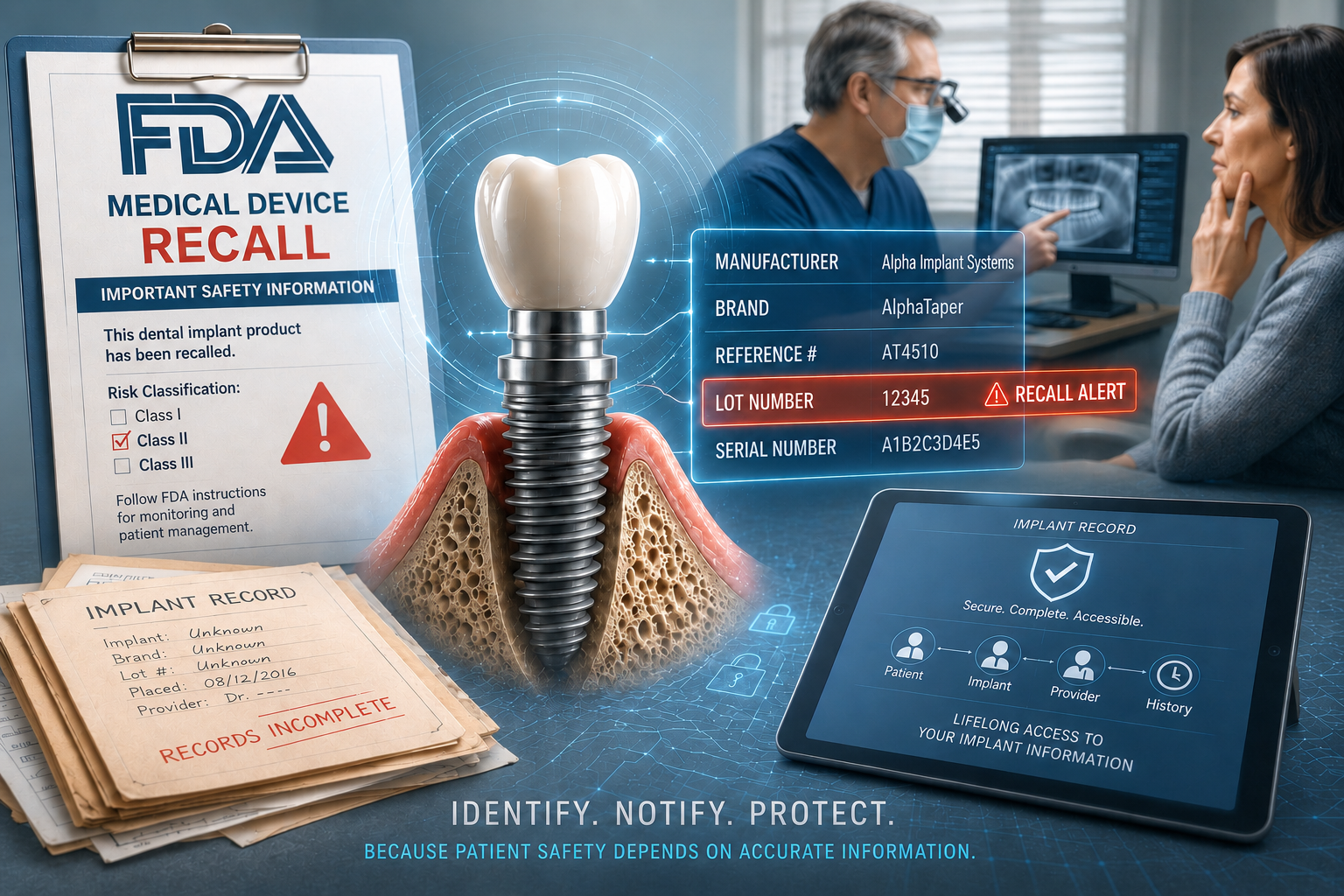
Many dental practices face incomplete records, paper charts, practice ownership changes, retired clinicians, or missing implant documentation. As patients relocate and records become fragmented across multiple systems over time, identifying the original implant and determining which patient received a recalled device can become difficult or even impossible, delaying both patient notification and appropriate treatment. If that implant product was later subject to a recall, identifying it becomes even more important.
Suppose a manufacturer recalls Lot #12345 of an implant placed eight years ago.
To identify affected patients, the dental office must know:
manufacturer
implant brand
diameter
reference number
lot number
which patient received that exact implant
This is precisely where a dynamic, digital, lifelong implant record such as id2 provides value by ensuring that both patients and their dental professionals have secure, long-term access to critical implant information whenever it is needed. If every implant's manufacturer, reference number, lot number, and patient were securely linked at the time of placement, a recall could be instantly cross-referenced, allowing affected patients and providers to be identified rather than relying on manual record searches.
As implant dentistry continues to expand globally, the importance of implant identity and device traceability becomes increasingly clear.
Implant dentistry has made extraordinary advances in surgical techniques, biomaterials, and digital workflows. The question isn't whether dental implant recalls are common. The question is whether every patient could be found if one affected them.
Because in most industries, the product follows the consumer.
A permanent medical device deserves a permanent, patient-accessible record, not one tied to a single office or chart.
References
U.S. Food and Drug Administration. What is a Medical Device Recall? FDA Website. Updated July 2023. Accessed March 12, 2026.
https://www.fda.gov/medical-devices/medical-device-recalls-and-early-alerts/what-medical-device-recallU.S. Food and Drug Administration. Recalls, Corrections and Removals (Medical Devices). FDA Website. Accessed March 12, 2026.
https://www.fda.gov/medical-devices/postmarket-requirements-devices/recalls-corrections-and-removals-devicesU.S. Food and Drug Administration. Medical Device Recalls and Safety Alerts Database. FDA Website. Accessed March 12, 2026.
https://www.fda.gov/medical-devices/medical-device-safety/medical-device-recalls-and-early-alertsU.S. Food and Drug Administration. Distinguishing Medical Device Recalls from Medical Device Enhancements. FDA Guidance Document. Accessed March 12, 2026.
https://www.fda.gov/regulatory-information/search-fda-guidance-documents/distinguishing-medical-device-recalls-medical-device-enhancementsCode of Federal Regulations. 21 CFR Part 7 – Enforcement Policy: Recalls (Including Product Corrections) – Guidelines on Policy, Procedures, and Industry Responsibilities. U.S. Food and Drug Administration. Accessed March 12, 2026.
https://www.ecfr.gov/current/title-21/part-7U.S. Food and Drug Administration. open FDA Device Recall API Overview. Accessed March 12, 2026.
https://open.fda.gov/apis/device/recall/Institute of Medicine. Medical Devices and the Public’s Health: The FDA 510(k) Clearance Process at 35 Years. Washington, DC: National Academies Press; 2011. https://www.nationalacademies.org/publications/13150?utm_source=chatgpt.com