Once upon a time, implant design meant something.
Years of research and development, surface science, biomechanics, and clinical validation, true innovation driven by better patient outcomes. But somewhere along the way, the industry shifted.
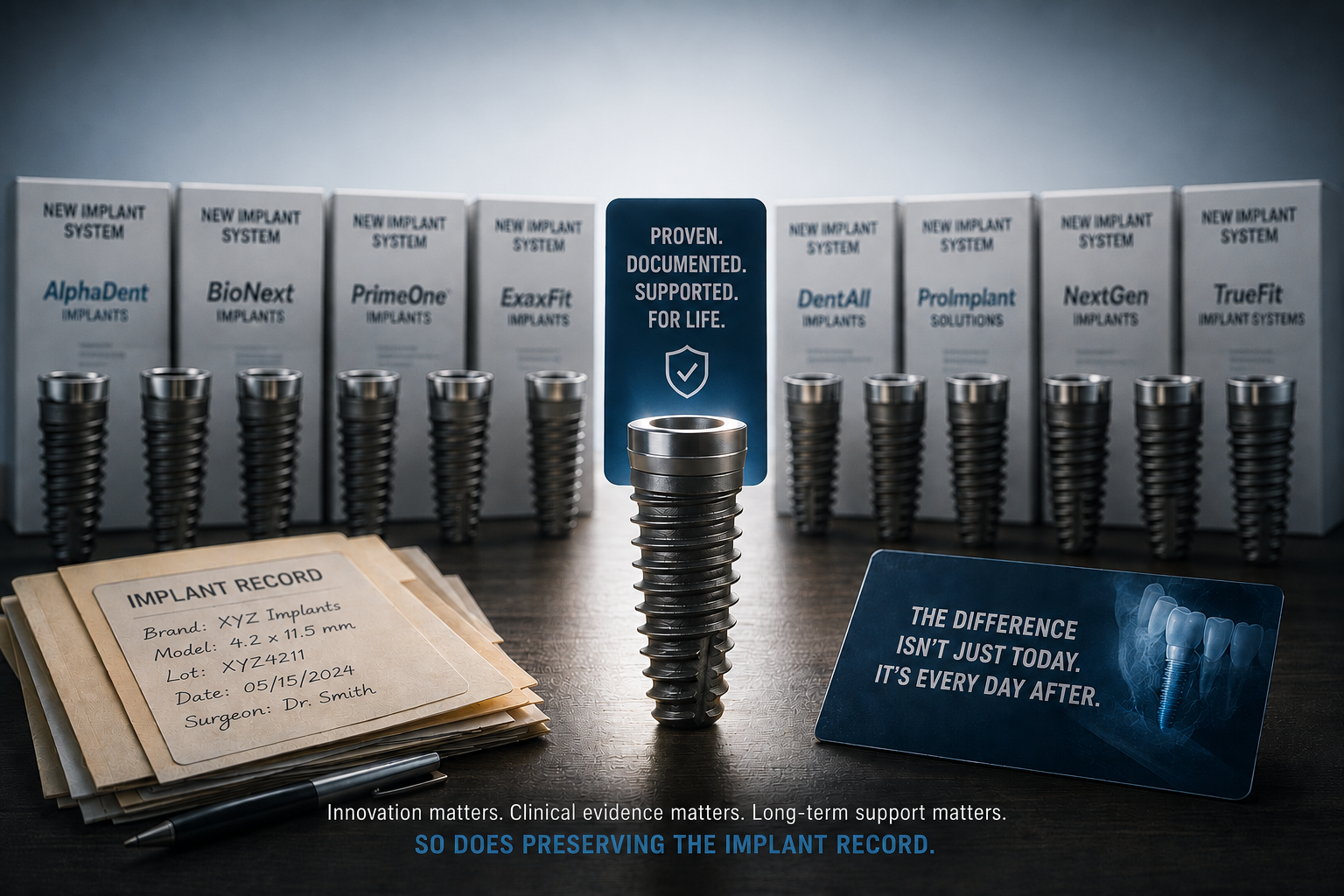
Now, every Tom, Dick, and Harry is launching their own “NEW” implant system.
Except… they’re not new.
They’re often carbon copies of established designs, same connection, similar dimensions, little innovation. Many enter the market with limited long-term clinical evidence, relying instead on lower pricing and new branding.
Why?
Not to improve healing.
Not to advance surgical precision.
Not to simplify restorative treatment.
Too often, it’s simply because the design can be replicated. The real concern isn’t just the number of implant systems, it’s what happens years later.
Dental implants are lifelong medical devices. They require periodic maintenance, restorative repairs, and, at times, replacement components. Continuity of care isn’t optional, it’s essential. Every patient deserves to know exactly which implant brand and model has been placed in their mouth. That information should remain with the patient for life and be readily available to any dentist, specialist, or laboratory involved in their care.
Without an accurate implant record, clinicians may be forced to identify implants by guesswork or radiographs, increasing treatment complexity, delaying care, and creating the risk of incompatible components being used.
Knowing the original implant system helps ensure that genuine OEM components can be selected whenever appropriate, preserving the manufacturer’s intended design, protecting available warranties, reducing unnecessary costs, and providing greater confidence in long-term restorative success.
In the end, choosing an implant system isn’t simply about today’s procedure, it’s about decades of patient care. Innovation matters. Clinical evidence matters. Long-term support matters. And so does preserving the implant record.
Because biology doesn’t care about discounts, but patients will always care about the quality, traceability, and longevity of the treatment they receive.